How to temper chocolate
topcook.tomathouse.comPreparation:
Should chocolate be tempered?
If you want to make candies with a smooth, shiny exterior but don't want to spend time tempering them, you have two options. You can use ready-made glaze (a product called Candy Melts) instead of regular melted chocolate—it will also retain its properties at room temperature. If you decide to melt regular chocolate, keep the coated candies in the refrigerator and remove them shortly before serving to prevent them from discoloring..
You will need:
- Minimum 450 gr. chocolate
- Chocolate thermometer
- Microwave oven
- Microwave-safe glass bowl
- Rubber spatula
- Choose chocolateTempering temperatures vary for dark, milk, and white chocolate. It's best to use a chocolate mass of at least 450 grams, as a larger volume will maintain the desired texture longer and will prevent cracking. If this is more than you need, you can always save the excess for future use. Dark chocolate (70% cocoa) is easiest to temper, so if you're new to tempering, I recommend using this type, not diluted with milk powder. Once you've mastered the technique, you can experiment with milk or white chocolate. Make sure the chocolate you choose has a good texture, meaning it's shiny and firm. If it has white or gray streaks, or if it's crumbly, it's not the best choice for this tempering method. Also, avoid using chocolate chips, as they are much more difficult to temper.
- Chop the chocolateSet aside about a quarter of the chocolate. Chop the remaining 3/4 into small pieces and place in a microwave-safe bowl.
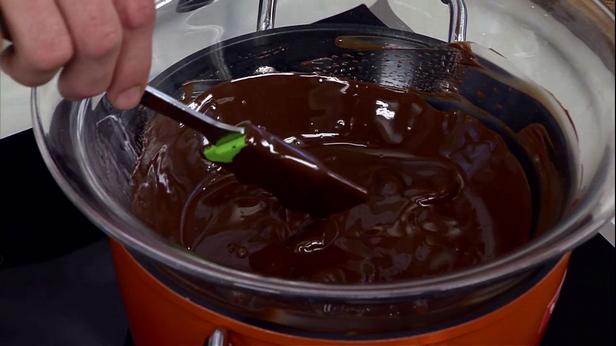
- Melt the chocolateMicrowave the bowl with the chocolate pieces in 30-second intervals, stirring after each. Heat and stir until the melted chocolate has completely melted the remaining pieces and the chocolate mixture is smooth.
Heat dark chocolate to 115°F (46°C), or milk or white chocolate to 118°F (43°C). Once the chocolate has melted, check the temperature with a thermometer. If it's below 115°F (46°C), heat the chocolate in short intervals until it reaches this temperature, but keep a close eye on it. Don't let it get hotter than it needs to be, or it may become dense, unyielding, or even burn.
Add the remaining chocolate to the bowl and stir gently to combine, lowering the temperature. Stir almost constantly, melting the remaining chocolate. I use a scraping motion to incorporate it into the melted mixture. The warm chocolate will melt the remaining chocolate, which in turn helps cool the melted chocolate.
Cool dark chocolate to 32°C (90°F), milk or white chocolate to 30°C (86°F). Continue stirring the chocolate until it cools to this temperature.
Check the density of the chocolateSpread a small amount of chocolate onto a piece of parchment or waxed paper with a spatula and watch it set. Well-tempered chocolate will begin to set within a few minutes. You'll see it lose its shine and become more matte, then set at the edges. In a cool room, the layer of tempered chocolate should set within 4-6 minutes. If it doesn't appear to be tempered, continue stirring and cooling the chocolate another 1-2 degrees Celsius, then check again. Chocolate from different manufacturers, as well as different environmental conditions, sometimes require different tempering temperatures.
Remove any possible pieces in the melted chocolate.If a piece of chocolate has not completely melted, remove it from the melted mass to prevent it from cooling too quickly.
Your chocolate is tempered and ready! Now it's time to make your candies. You can coat the finished, cooled chocolate with tempered chocolate, which you'll need to melt to working temperature. You can also dip the candies or truffles in it to add shine.
Usage advice
A working temperature of 29-31°C (84-88°F) for dark chocolate and 30°C (86°F) for milk or white chocolate will allow you to comfortably coat the chocolate. You can hold it over a pan of warm (but not boiling) water, stirring occasionally, or try placing it on a heating pad set to low heat and placing a towel between the heating pad and the bowl. Whichever method you choose, it's important to monitor the temperature and stir the chocolate frequently to maintain a consistent temperature throughout.